Tag: Financial Model

  • Risk modeling @ AGRE

    Risk modeling @ AGRE

    The objective of the project was to assess the relevance of the AGRE Risk model’s original calibration and assumptions in the context of the current economic climate.

    We investigated whether the model calibration performed during a low interest rate and moderate inflation economic environment is still relevant for the estimation of SCR risks and proposed adaptations to the model.

    The work was split in two macro phases:

    • Exploratory Phase
      • The objective was to collect the information about the evolution of the risks and current (post Covid) business environment from AGRE professionals
    • Implementation Phase
      • The objective of this phase was to translate the business and risk opinions, as well all other requirements emerged during the exploratory phase, into concrete modifications and updates of the Boni Mali Risk model.

    We performed the tasks and updated the relevant risk drivers identified by economists and real estate experts such as:

    • Cost of borrowing
      • Rapid interest rate hikes by central banks have increased the returns on risk-free government bonds. Commercial real estate investors demand more yield to justify holding such an illiquid asset. Rising rents can offset some of the impact on valuations. But the magnitude of the yield increase triggered by the sudden end of near-zero rates has overwhelmed whatever rent increases landlords can achieve.
    • Rising Vacancy Rates
      • This indicates a challenge in finding new tenants as old leases expire, and it puts downward pressure on rental prices and property values.
    • Refinancing Cliff
      • The commercial real estate market is facing a significant refinancing challenge in the coming years. Many commercial mortgages are due for refinancing, and with higher interest rates and increased vacancies, property owners may struggle to secure favorable refinancing terms. This could lead to defaults and financial instability in the market.
    • New regulations
      • New rules and regulations making it very expensive to refurbish and at the same time difficult to rebuild. Added to increased cost of construction. That puts downward pressure on the valuation of existing non-prime buildings

    Output

    The updated model was delivered as well as the necessary documentation and formation of stakeholders.

  • Forestbase

    Forestbase

    Modeling the Value of Nature: How We Helped Forestbase Unlock the True Worth of Forest Assets

    The Challenge

    Forests play a vital role in the planet’s ecological balance, yet their market valuation often fails to reflect this.

    Fragmentation, legal complexities, and limited liquidity have historically made forests difficult to price and even harder to transact.

    Forestbase approached us with a bold goal: build a model that could quantify not only the immediate economic value of forests, but also their unrealized potential as financial assets in an evolving market.

    Our Solution: The Forestbase Valuation Model

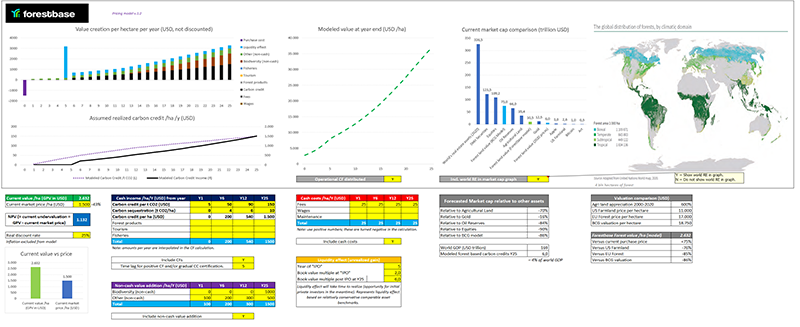
    We developed a hybrid financial model that integrates both traditional and forward-looking valuation techniques. Implemented in Excel for accessibility and transparency, the Forestbase Valuation Model is designed to evaluate forests at both a micro (individual investment) and macro (global asset class) level.

    Key Components:

    • Discounted Cash Flow (DCF): Captures direct economic returns, including carbon credits and sustainable forest product revenues. This aligns with growing government incentives aimed at transforming forests into yielding assets.
    • Valuation Growth Component: Projects the appreciation in asset value stemming from increased market access and improved liquidity, especially as initiatives like Natural Asset Companies (NACs) begin to take shape.

    This dual approach allows stakeholders to assess the full spectrum of a forest’s value—from immediate returns to future potential driven by regulatory and market evolution.

    Flexibility for the Future

    The model is built to adapt. It accommodates bespoke inputs for specific forests or generalized assumptions for global estimates. This flexibility ensures it remains relevant as new data, policies, and market mechanisms emerge. A centralized Dashboard interface makes calibration and scenario analysis intuitive, while a Present Value (PV) sheet powers the core calculations.

    Additionally, the model includes a benchmarking tool that compares the market capitalization of forests—based on output valuations—with other major asset classes like equities, gold, and farmland. This provides valuable perspective for institutional investors exploring diversification into natural capital.

    Why It Matters

    The Forestbase Valuation Model is more than just a spreadsheet—it’s a step toward redefining how we value the natural world. By enabling transparent, scenario-based pricing of forests, we are helping to catalyze the development of a liquid, investable market for natural assets. This is critical not just for investors, but for global sustainability.

    Ready to Rethink Nature as an Asset?

    If your organization is exploring innovative ways to integrate natural capital into its investment or sustainability strategies, we’d love to talk. Whether it’s designing valuation tools, modeling complex financial instruments, or advising on ESG-aligned investments, our team brings deep domain expertise and a track record of results.

    Let’s build the future of sustainable finance—together.